Tuesday, July 5, 2016

What A Group!

      Anna C.  is the proprietor of Gardens of Salonica, a Greek restaurant in SE Minneapolis.  Spring and fall she leads small group tours to Greece.  What Anna doesn't know about Greece is probably not worth knowing.  She' married to a Greek, her daughter and family lives in Athens, she speaks and teaches Greek, she's Greek Orthodox and seems to know people wherever we traveled in Greece.

   Jane J. in her amazing blog jwkjohnson3.wordpress.com said this about the trip....
"This type of trip is different from the other great adventures we’ve taken–it’s sort of a vagabond trek through Greece. Though Anna knows where she’s leading us and feeding us and has everything arranged, we have no specifically detailed itinerary–just a vague list of dates and places we’ll stay. So each day is an adventure for us. A monastery? A winery? A historical site? A beach? She leads and we follow. Sometimes we’re on time; other times we might be somewhere around the targeted hour. The tempo is slow and easy,"

    There were eight travelers plus Anna in the group.  Way back in my 'sensitivity training' days in the '70s we were told that nine was an ideal size group.  Perhaps that was correct because the group was definitely a high light for me.  There were two sisters, two female traveling companions who left husbands at home, my ministry partner from Iowa and his wife, plus, the curmudgeonette and me...the Traveling Curmudgeon.
    We laughed, ate, talked, ate, swam, ate, visited wineries (6), ate, rode bus, ferry, airplanes, ate, milked goats, ate, learned about Greece, ate, visited antiquities, ate, went to a farm, ate, some shopped, ate......... A high point for me were the meals together.  Anna would order food for our family style meal.  After four or five dishes arrive I'd think "wow! that was a great meal" only to discover that we were only half finished as dishes continued to pour from the kitchen.   A wonderful way to bond as we shared stories from our day and from our lives.
    This was my first experience of group travel and certainly has advantages...step off the plane or ferry and someone is waiting for you, our own private bus, no concern about logistics, a guide who took us to places I'd not find on my own, and companions with which to share the experiences.  Having someone else order the food was also fun.  The camaraderie of great companions was wonderful.


Shopping in Athens

Dinner on Santorini

image
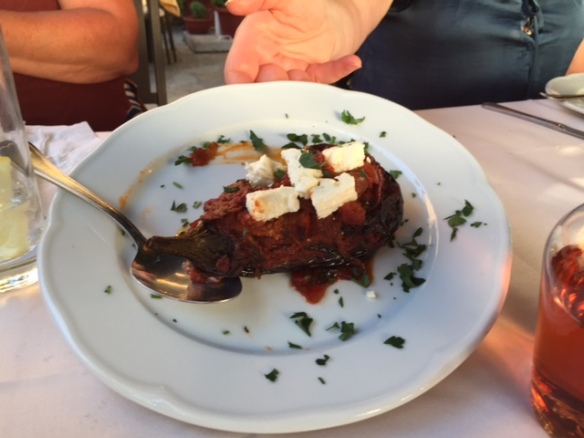
Stuffed egg plant with tomatoes and cheese (Jane J. pic.)
image
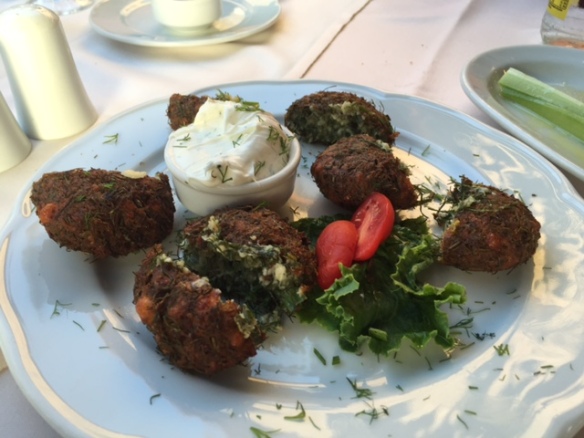
Fennel encrout with sauce (Jane J. pic.)
image
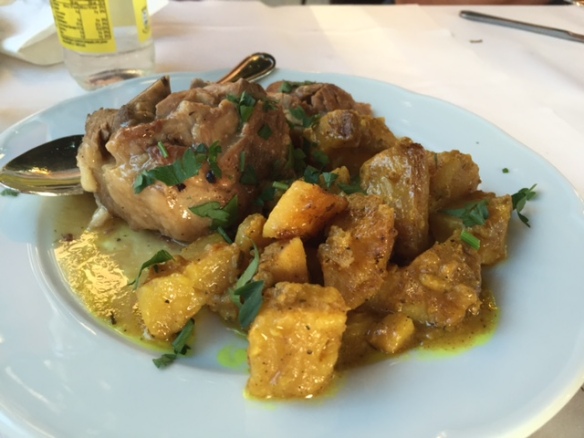
Rooster and potatoes  (Jane J. pic.)

Monday, July 4, 2016

Olive Trees

    (If you want to read an extremely good narrative account of our Greece trip, Jane J., one of our travel companions, kept a blog at jwkjohnson3.wordpress.com  She has wonderful food pics which I do not have.  I will cross reference her blog with mine.  My blog, like me, will  be very random.)

   "I think I shall never see, a poem as beautiful as a tree" wrote Joyce Kilmer, whom I was surprised to learn, was a man,   Greece is swathed in Olive trees from valleys and high up mountain sides. There are many orange groves and vineyards as well, but, they are not nearly as ubiquitous as olive trees.
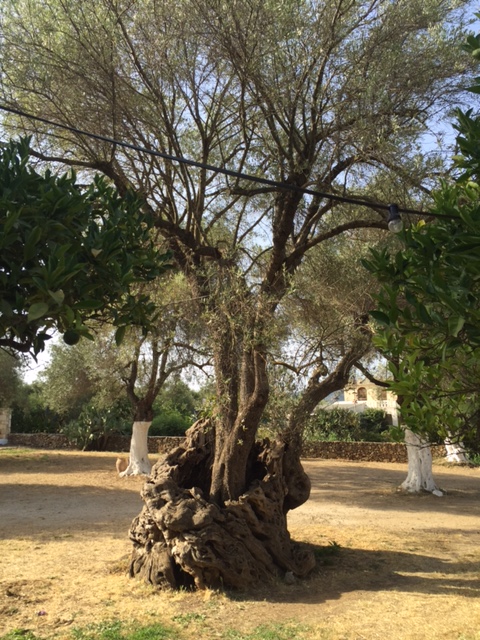
   Every olive tree in Greece has an owner and ownership is hereditary.  In fact we visited one winery on Crete, Manouskis,  owned by a wealthy entrepreneur who made his money in America and returned to his childhood home to found a business to aid the local economy.  On his property was an olive tree that was between 1300 and 1500 years old.  originally given to a priest, which the vineyard owner did not own.  Jane took a good pic of this tree. (see below) (Cross reference with Day 10, of Jane. J's blog.) It's a bit like mineral rights in America which are separate from land surface rights.
    Olives like light and air.  Therefore, olive tress are pruned to enhance olives reaching light and air.  The trunk is severed about six feet above ground and the branches curve upward from the remaining stump so the trees are shaped a bit like an inverted umbrella and are not very tall...perhaps fifteen feet.
   At the city of Messolongi (Jane's blog Day 5) we were hosted by a family who grow olives and who also operate an olive extraction business.  One of my first learnings was that it is hot in the sunshine in in olive grove when it's 113 degrees...about the top end of my comfort zone.  The Curmudgeonette discovered olives she liked for the first time ever.

image
The 1300-1500 year old olive tree.  (Jane J. picture)

In the olive grove...these trees are 200 years old.  Kleopatra, dressed in white, was our hostess for the study of olives.
image.jpeg
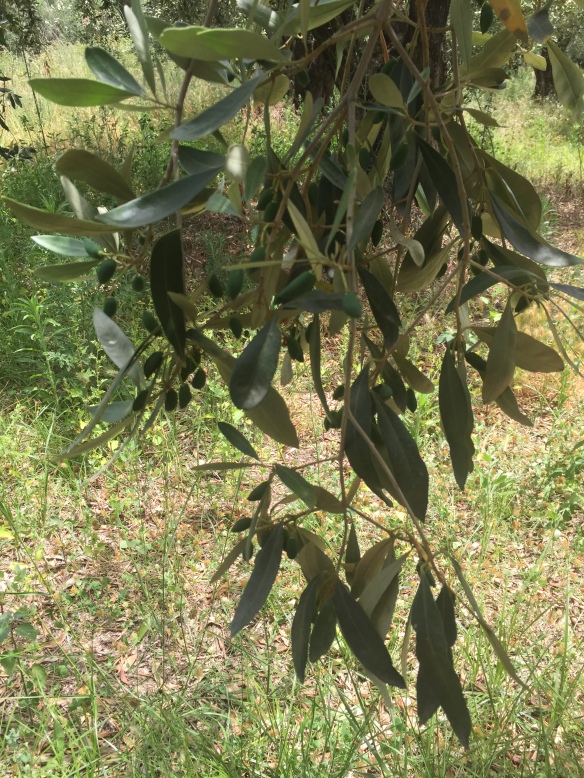
Olives on the tree. (Jane J. picture)
Containers for olives.

Products for sale at the olive pressers place.


An antique olive press which was powered by a donkey.   Now olives are pressed  in modern stainless steel equipment with hydraulic pressure.
Olive trees fill the valley floor..picture taken from Delphi.

Sunday, July 3, 2016

Blogging Resumption: re Greece (and other things)

   On our Greece trek I only carried a smart phone which is no way to blog.  Therefore, I suspended blogging until now that I'm back at my desktop.  So I will be blogging in my typical, random fashion about our Greek experiences.

I found this in today's Writer's Almanac so, with it's connection to Greece thought I'd reprint it.

Today is the beginning of the Dog Days of summer, 40 days of especially hot and humid weather with little rainfall, according to the Farmers' Almanac. The name came from the ancient Greeks. They believed that Sirius, the "dog star," which rose with the sun at that time, was adding to the sun's heat. They also believed that the weather made dogs go mad. The Romans tried to appease Sirius by sacrificing a brown dog at the start of the Dog Days. For the Egyptians, the arrival of Dog Days marked the beginning of the Nile's flooding season, as well as their New Year celebrations.
"Dog Days" has been adopted by the stock market, because the markets tend to be slow and sluggish; it's also come to mean any period of stagnation or inactivity.
The Corinth Canal begun by Nero with 6000 Jewish slaves and completed by the French at the end of the 19th century.  It connects the Ionian and Aegean Seas  through the Corinth Isthmus.  Cut  through solid rock 4 miles long, 30 yards wide and the sides are 10 yards high.

Thursday, June 16, 2016

Athens to Crete

     Yesterday we made the hike from our hotel to the Acropolis and admired the Pantheon.  Ah how history repeats.  Christians destroyed much of the statuary before turning the Pantheon into a place of Christian worship and today ISIL destroys sites in Syria and Iraq.
    The Acropolis stands high above Athens offering a view of the city to the sea beyond.  A nice breeze accompanied us on a moderate day.  Temperatures are predicted to be in the 100s here in the next days.
    Athens is a city that eat outdoors with endless restaurants on the street.  Billed as a "food and wine tour" this experience will certainly fatten me up if I keep eating as I have.  Think "Greek wedding" type of food.  Last night, after climbing endless steps, we ate on a roof top with a beautiful view of Athens in one direction and  the Acropolis the other.
   I'd hoped to share some pictures but after waiting endlessly for this computer to upload them I gave so they will come later.  Today we leave Athens for Crete.

Tuesday, June 14, 2016

Greetings From Athens

     The Curmudgeonette and I are in Greece for 17 days having just arrived hours ago.  K. & B.G., from Iowa City are with us on a small group tour...8 people...billed as "a food and wine tour".  There are four foci of the trip; antiquities, food, wine and beaches.  We will visit the islands of Crete and Santorini five wineries.  Anna, our guide, runs the Gardens of Slonika restaurant in NE Minneapolis.  
    I'll post on this blog as time and internet access permit.

Saturday, June 4, 2016

Perhaps Men Should Not Vote

Writer's Almanac 6/4/16

The United States Congress passed the 19th Amendment to the Constitution on this date in 1919. The amendment, which gave women the right to vote, had been a long time in coming. The women's suffrage movement had arisen along with the abolitionist movement in the mid-1800s. Many women were active in both causes, and Frederick Douglass often spoke at women's rights rallies. In 1848, Elizabeth Cady Stanton drafted her "Declaration of Sentiments," which adopted the language of the Declaration of Independence in calling for voting rights for women: "We hold these truths to be self-evident: that all men and women are created equal; that they are endowed by their Creator with certain inalienable rights; that among these are life, liberty, and the pursuit of happiness; that to secure these rights governments are instituted, deriving their just powers from the consent of the governed. [...] Now, in view of this entire disfranchisement of one-half the people of this country [...] we insist that they have immediate admission to all the rights and privileges which belong to them as citizens of the United States."
Stanton also drafted the original Constitutional Amendment, with help from Susan B. Anthony. It was first introduced in 1878 and languished in committee for nine years before it came up for a vote. It was defeated and, although individual states passed laws allowing women the right to vote, a national amendment wasn't considered again until 1914. President Woodrow Wilson backed it in 1918, saying: "We have made partners of the women in this war. Shall we admit them only to a partnership of suffering and sacrifice and toil and not to a partnership of right?" The 19th Amendment was ratified by the states and took effect in August 1920. It states: "The right of citizens of the United States to vote shall not be denied or abridged by the United States or by any State on account of sex."

Thursday, June 2, 2016

Martha Washington; Writers Almanac 6/2/2016

Today is the birthday of Martha Washington, born Martha Dandridge on the Chestnut Grove Plantation in New Kent County, Virginia (1731). When she was 18, she married Daniel Parke Custis, whom she'd met at church. Custis was in his late 30s, and a prosperous landowner of a 15,000-acre plantation called White House. He had never been married because his father disapproved of every woman he had courted. He and Martha had four children, only two of whom - Jack and Patsy - survived beyond childhood. When Custis died in 1757, Martha inherited the plantation, including 300 slaves and well over 17,000 acres of land.
Martha was only 26 when she became a widow. Her marriage had been happy, and she hoped to have more children, so she planned to remarry. What's more, she was now wealthy and could follow her heart in matrimonial matters, rather than making a financially advantageous match. The 26-year-old military man and fellow Virginian George Washington had also recently inherited an estate - Mount Vernon - upon his brother's death. While visiting Williamsburg, he heard about the wealthy young widow. He paid a call on her, and made a point to tip her household slaves lavishly. At 2,000 acres, Mount Vernon was small compared to Martha's plantation, but money was not her first consideration. Colonel Washington was tall and handsome, and had a reputation for bravery and honor. Martha was petite, engaging, and had a cool head for business, as her efficient handling of Custis's tobacco business had already shown.
George resigned his military commission in 1758, and he and Martha married in January 1759. She trusted him enough that she opted not to draft a prenuptial agreement, as most widows in her situation would have done. She also made him the legal guardian of her two surviving Custis children. She ordered her wedding clothes - including made-to-order, high-fashion purple silk shoes - from London. Throughout their marriage, George took pleasure in ordering shoes for Martha, and was not shy about returning any that were deemed unsatisfactory. In one letter, he wrote, "Mrs. Washington's slippers and clogs have come safe to hand, the latter, however, are not as she wished to have [...] and will, by the first convenient opportunity, return the clogs to Mr. Palmer and get a pair of galoshes."
Martha expected to lead a quiet and comfortable life at home. But during the Revolutionary War, her husband did not return home to Mount Vernon for six years. He often requested her presence at the Continental Army's winter encampment, and she made the exhausting journey to be at his side. She made friends with the other officers' wives, worked as George's secretary, and comforted sick and wounded soldiers. She led a drive among area women to knit socks for the army, to keep them warm and dry during the brutal winter. She also hosted social events at the Valley Forge headquarters. But she missed her remaining son, Jack, and his children. Jack died in the war, and she raised two of his children; she had no more children of her own. In 1789, when George Washington was inaugurated as president, she became America's first first lady. Though she never sought out public life, and said she felt "more like a state prisoner than anything else," she made the best of it, knowing that she was setting the precedent for all the first ladies to come. She held weekly salons, hosting foreign dignitaries as well as ordinary members of the community. She felt it was important to show that the new government was accessible to all.
The Washingtons returned to Mount Vernon in 1797, after George declined to seek a third term as president. Her social duties continued unabated. When her husband died in 1799, she burned all of their correspondence. She often spoke of how terribly she missed him. She died two and a half years later